Opinion
My experience with an electric car.
Posted
24 January 2026
I am currently working on a project that requires me to travel to the client’s facilities several times a week. That meant a 320 km round trip. Initially, I chose to use my own car (diesel), but as the weeks went by, that option became increasingly complicated. So I asked the project lead whether I could use a vehicle from Capgemini’s fleet. That’s how my first experience with a 100% electric vehicle began.
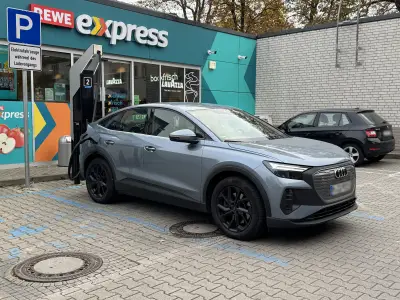
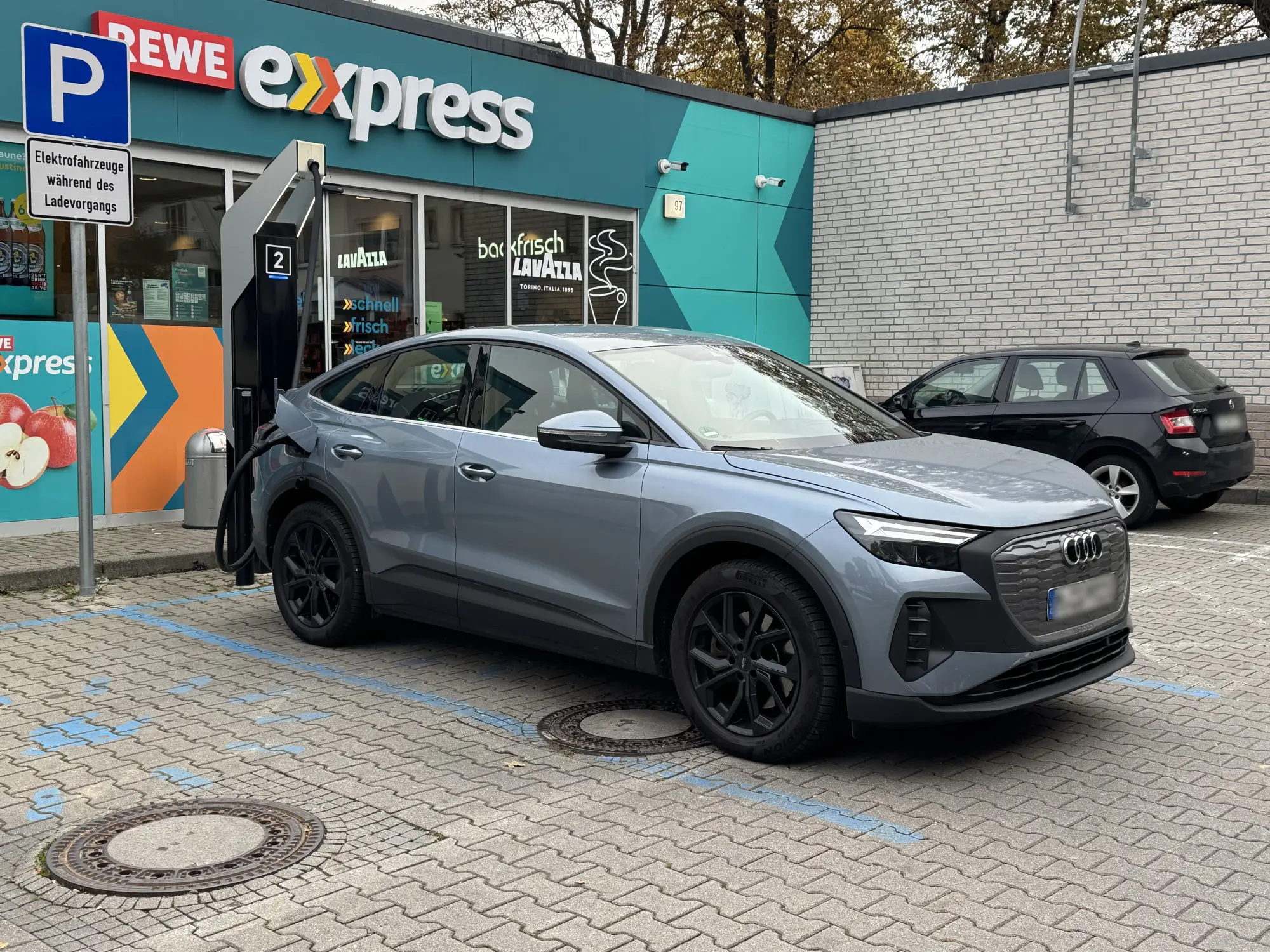
At first, everything looked really promising: Capgemini provided me with an Audi Q4 Sportback e-tron featuring a 77 kWh battery and a nominal range of 573 km.
Great — that would easily be enough for daily use with just a single charge. And even though charging costs weren’t particularly relevant for me, since a charging card was included in the leasing contract, I naturally assumed it would still be much cheaper than doing the trip with a gasoline car.
The car was excellent. What impressed me most at the beginning was the connectivity (I could activate the air conditioning or seat heating from my phone before reaching the car), the cruise control with vehicle detection, the lane assist, and the head‑up display (very well integrated with the navigation system). And the responsiveness of an electric car was nothing like that of a combustion engine. Fantastic. A really well‑finished and extremely comfortable vehicle.
The first surprise came with the range. So: I said the range was 573 km, right? Let’s get out the calculator then. The nominal consumption, according to the manufacturer, is between 18.3 and 15.4 kWh per 100 km. Okay, so let’s take the 77 kWh (battery capacity), divide them by that minimum of 15.4 kWh, and multiply by 100 km — and we get… 500 km. That would be the real range with a consumption of 15.4 kWh. I suppose you might reach that consumption without using the air conditioning and… at what speed exactly?
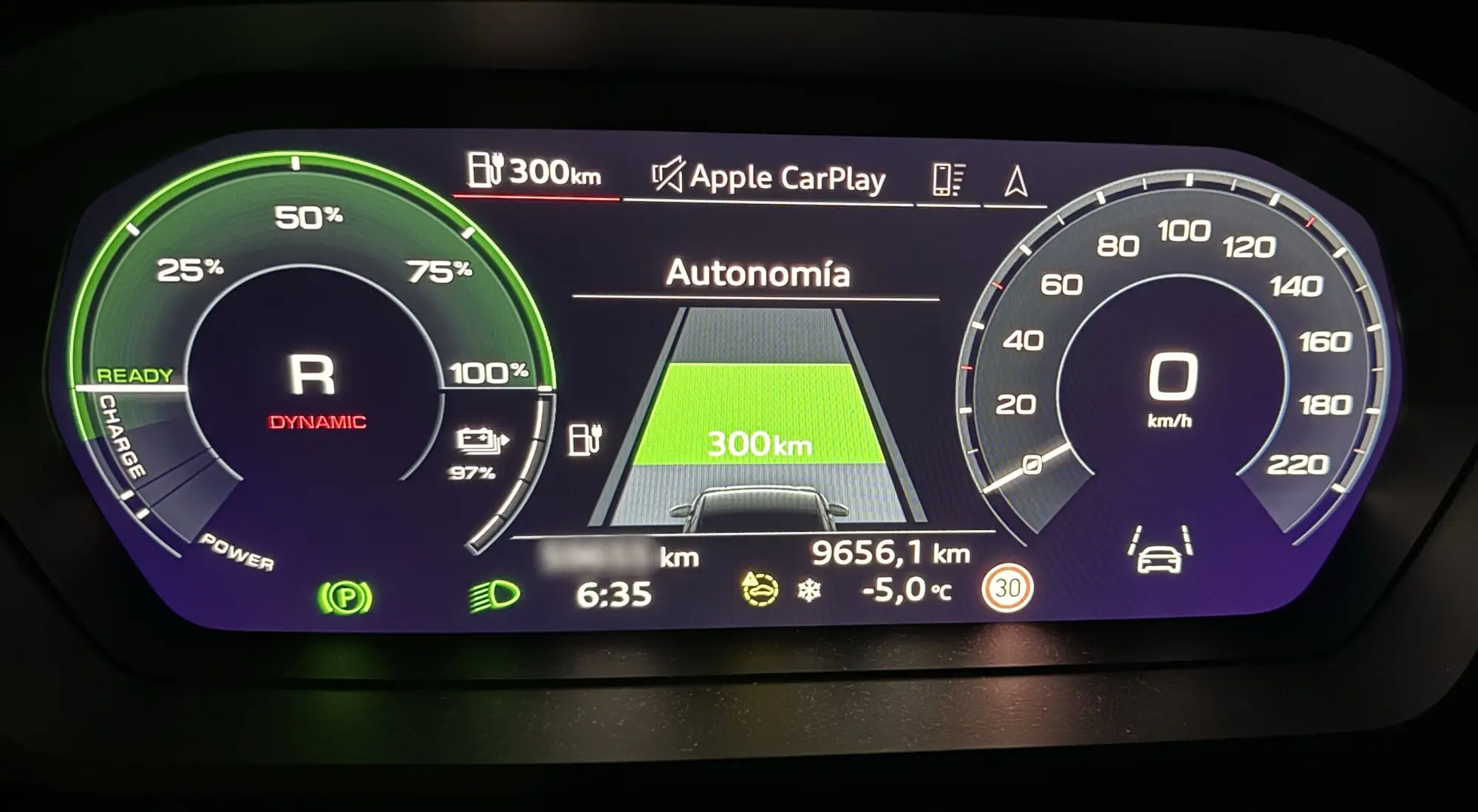
The truth is that, using the climate control in a “normal” way and never exceeding 120 km/h on the motorway, I end up with a real consumption between 22 and 20 kWh. How? Well, yes: I have never achieved a real range above 400 km, and in winter it drops to 300 km. And I’m talking about full battery charges — which isn’t recommended if you want to keep the battery healthy — so it is absolutely impossible for me to cover the 320 km on a single charge. Well then…
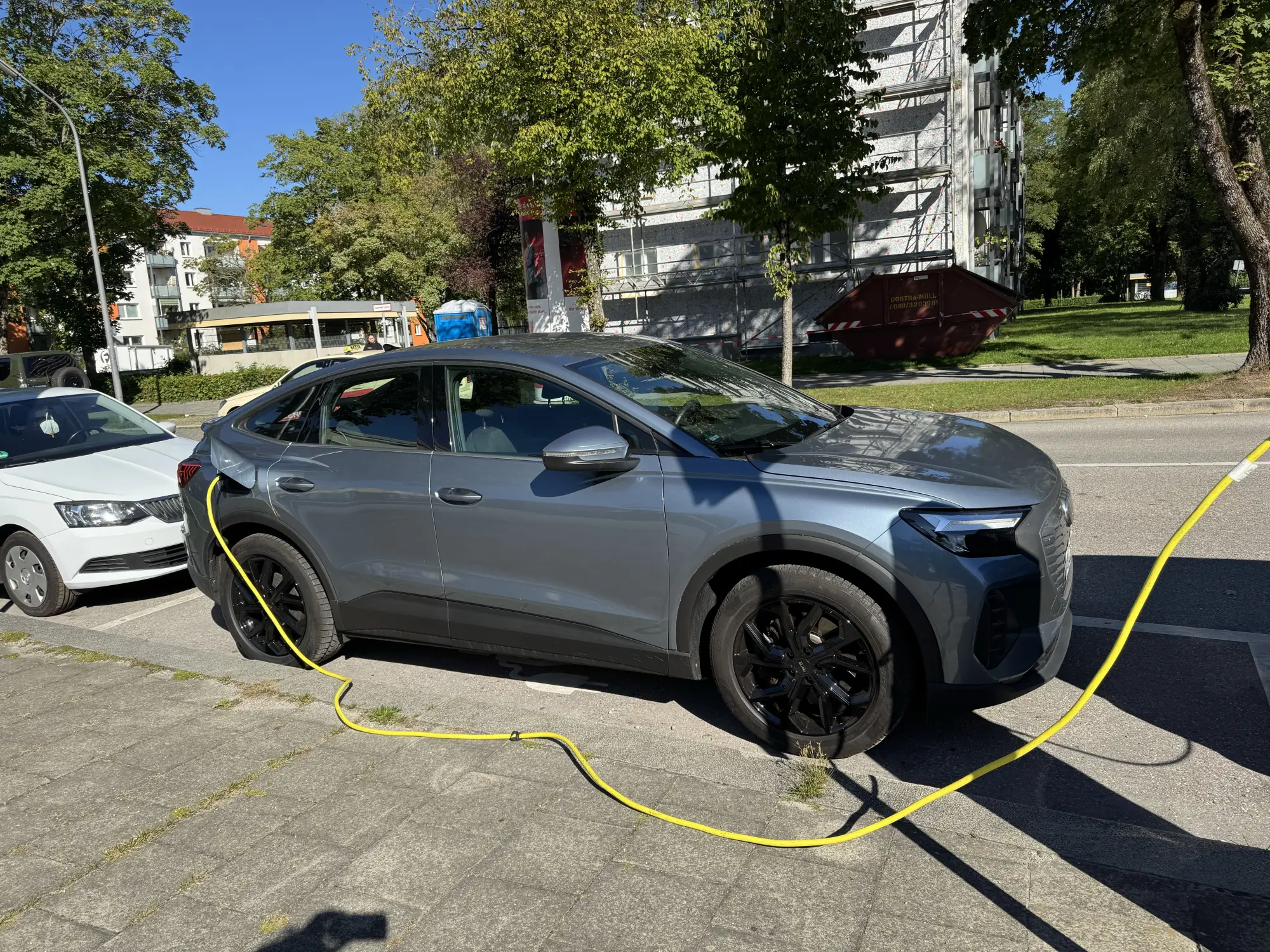
But the story doesn’t end there. As I mentioned earlier, I have a charging card, and since I don’t have a charging station in my garage, I decided to use the public SWM chargers installed on the streets of Munich. That was the second surprise. The chargers don’t display the applied tariff anywhere, and at the end of the charging session you can see how much energy was delivered, but not the total cost. Well, SWM chargers charge an eye‑watering €0.69 per kWh while offering a maximum output of 22 kW. This means that charging the full 77 kWh battery costs… €53. For 400 km. Sorry, but wasn’t charging an electric car supposed to be cheaper than gasoline? Turns out it isn’t.
And of course, charging is much slower than filling up a conventional car: since the chargers don’t actually deliver the promised 22 kW — especially when two cars are charging simultaneously on the same unit — it takes between 5 and 6 hours to fully charge the battery.
of real maximum range.
for driving 400 Km.
to charge the battery in a 11 kw point.
/ 100 km of real minimum consumption.
Conclusion: We have an electric car that costs more than a conventional one, offers a much lower range, requires extremely long charging times, and whose charging costs are equivalent to the fuel cost of doing the same trip with a gasoline vehicle… So where exactly is the advantage of the electric car?